


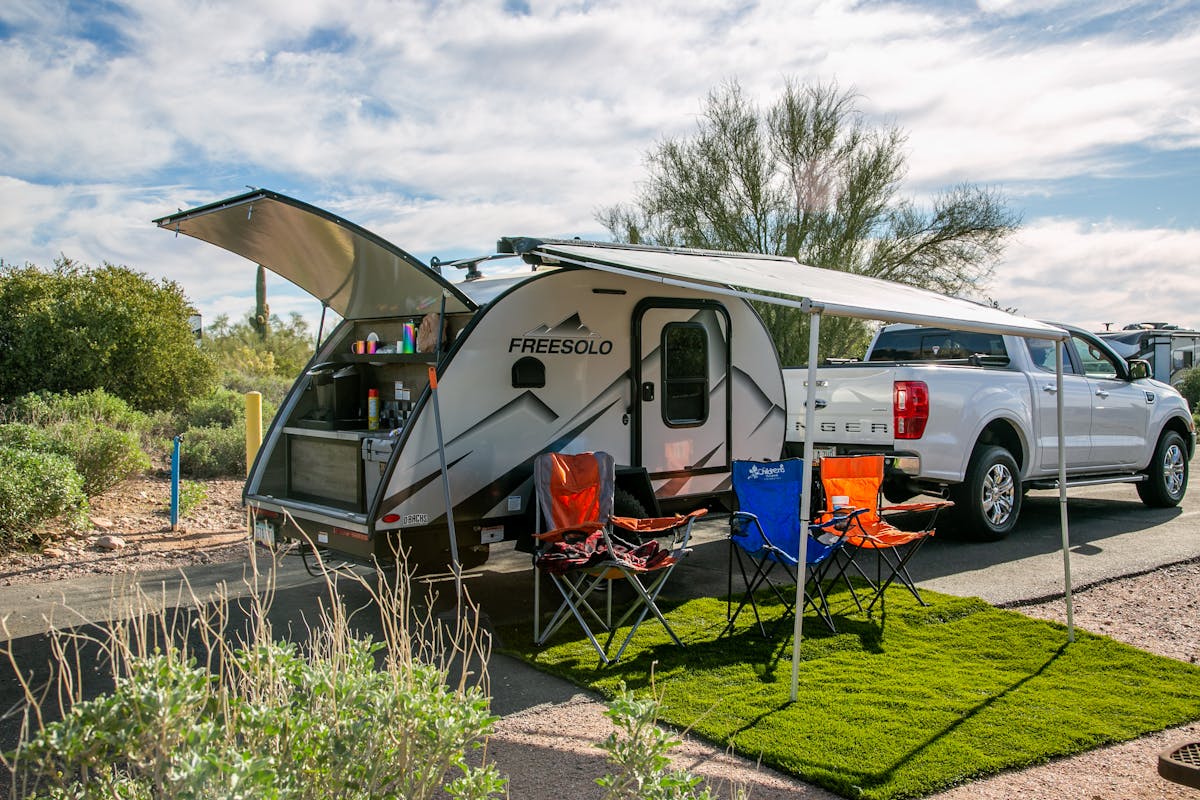
Boondocking Power Management: How to Make Your Batteries Last
You’ve found the perfect dispersed campsite. No neighbors, no noise, no hookups. Just you, your rig, and a view that makes you want to stay for a week. Your battery gauge reads full. Life is good.
Then reality sets in. The furnace kicks on overnight, you run the lights for a few hours, charge your phone, and by morning two your battery gauge is already looking nervous. Most RVers last 2-3 days off-grid before they’re packing up or firing up the generator. But experienced boondockers routinely stretch that to a week or more — not because they have better equipment, but because they understand where their power actually goes. Here’s the complete playbook.
Know Your Power Budget
The single most important thing you can do before heading off-grid is figure out how many amp-hours you actually use in a day. Without that number, you’re just guessing — and guessing leads to dead batteries on day two.
The formula is simple: Watts x Hours = Watt-hours (Wh). Then divide by 12 to convert to amp-hours (Ah) for a standard 12V system. A 15-watt vent fan running for 8 hours uses 120 Wh, or 10 Ah from your battery bank.
Here’s what the most common 12V DC appliances actually draw:
| Appliance | Amps (12V DC) | Typical Daily Use | Daily Ah |
|---|---|---|---|
| LED light (per fixture) | 0.12–0.20 | 5 hours | 0.6–1.0 |
| Water pump | 4–6 | 15 min total | 1.0–1.5 |
| Roof vent fan | 2.5 | 6 hours | 15.0 |
| Fridge control board (propane mode) | 0.4–0.9 | 24 hours | 9.6–21.6 |
| Phone charger | 0.5–1.0 | 3 hours | 1.5–3.0 |
| Furnace fan | 8–10 | 4 hours (cycling) | 32–40 |
| CO/propane detector | 0.1 | 24 hours | 2.4 |
| TV antenna booster | 0.2 | 4 hours | 0.8 |
A conservative boondocking day — LED lights, propane fridge, water pump, vent fan, phone charging — comes in around 30-50 Ah. Add the furnace fan on a cold night and you could hit 80-100 Ah easily.
Use the free Arvee AmpSmart calculator to build a personalized power budget for your specific rig and camping style. Plug in your appliances, set your usage hours, and see your daily total instantly.
Find and Kill Phantom Loads
Phantom loads are the appliances that draw power even when you think everything is off. They’re silent, invisible, and they can drain your batteries while you sleep.
The usual suspects:
- Inverter on standby — draws 1-2 amps with nothing plugged in. That’s 24-48 Ah per day doing absolutely nothing.
- TV in “off” mode — still drawing power unless you flip its physical switch or unplug it.
- Antenna booster — pulls about 0.5 amps, often left powered 24/7 by accident.
- Cell signal booster — draws roughly 1.7 amps. Great when you need it, expensive when you don’t.
- USB outlets — each one draws a small amount in standby, and a typical RV has several.
Here’s the math that makes phantom loads dangerous: a steady 1-amp phantom drain consumes 24 Ah per day. On a 100Ah lead-acid battery with only 50Ah of usable capacity, that single amp drains your entire usable battery in just two days — without you touching a single switch.
The quickest wins: flip the inverter fully off when you’re not running AC appliances, use physical disconnect switches for boosters and entertainment systems, and unplug anything with a wall wart or LED indicator light.
Three Upgrades That Pay for Themselves
You can buy a lot of extra off-grid time with just three targeted upgrades. Each one addresses one of the biggest power drains in a typical RV.
LED Lighting
This is the single best bang-for-your-buck upgrade you can make. The numbers are dramatic: 12 incandescent lights draw 19.2 amps total. Replace them all with LEDs and the same 12 fixtures draw 1.44 amps — a 13x reduction. A single incandescent ceiling light pulls 1.6 amps; its LED replacement pulls 0.12 amps.
Most RV light fixtures use standard bulb types (G4 bi-pin, 1141/1156 bayonet, or wedge base) that have direct LED replacements. No rewiring needed — just swap the bulbs. The whole RV can be done in an afternoon for under $50. Bonus: LEDs generate far less heat than incandescent bulbs, which reduces your cooling load in summer — fewer vent fan hours, less AC demand.
Alternative Heating
Your RV’s built-in furnace runs on propane, but its blower fan runs on 12V battery power — and it draws 8-10 amps every time it cycles. On a cold night with the furnace running several hours, that fan alone can consume 40-80 Ah. It’s one of the single largest battery loads in any RV.
A catalytic propane heater (like the Olympian Wave series) or a portable radiant heater (like the Mr. Heater Buddy) uses zero electricity. No fan, no battery draw, nearly 100% fuel efficient, and silent. If you boondock in cold weather, this upgrade can double your battery life overnight.
12V Compressor Fridge
If your RV has a residential refrigerator running through the inverter, it’s pulling 35+ amps from your 12V system to keep your food cold. A 12V compressor fridge draws just 1-3 amps — a fraction of the load. Even if your existing fridge can run on propane, the 12V compressor option is worth considering if you’re upgrading anyway.
Smart Habits That Stretch Your Batteries
Good habits cost nothing and can cut your daily consumption by 30-50%. These are the practices experienced boondockers follow without even thinking about them:
- Flip the inverter off when you’re not actively using an AC appliance. That standby draw of 1-2 amps adds up fast.
- Use 12V directly for lights, fans, and USB charging. Running them through the inverter wastes 10-15% of the power in conversion losses.
- Charge devices in your tow vehicle. Your vehicle’s alternator produces power for free while you’re driving or running the engine. Use it.
- Cook with propane. A stovetop percolator or moka pot uses zero battery power. An electric coffee maker draws 900-1,200 watts through your inverter.
- Time high-draw activities for peak solar hours. If you have solar panels, run the microwave, charge the laptop, and vacuum during midday when your panels are producing maximum power. Let the sun pay for it.
- Pre-cool the fridge before leaving the campground. A cold fridge runs less often — and temperature matters more than you think. A fridge in 90-degree ambient heat uses 50-100% more power than one at 70 degrees. Park in shade when you can, improve ventilation behind the fridge, minimize door openings, and use a separate ice chest for drinks you grab frequently.
- Insulate your windows. Reflectix or thermal curtains reduce both heating and cooling loads, which means fewer furnace cycles and less vent fan time.
Know Your State of Charge
Your RV’s factory battery gauge — the one with the green/yellow/red LEDs on the monitor panel — is almost certainly lying to you. Most factory gauges read voltage only and display a rough guess. They’re inaccurate under load, inaccurate while charging, and especially misleading with lithium batteries.
Here’s what resting voltage actually means for a lead-acid battery (measured after 4+ hours with no load or charging):
| Voltage | State of Charge |
|---|---|
| 12.7–12.8V | 100% |
| 12.4V | 75% |
| 12.2V | 50% — stop here |
| 12.0V | 25% |
| 11.8V | 0% — battery damage |
The critical number is 12.2V. Discharging a lead-acid battery below 50% SOC significantly shortens its lifespan. Do it repeatedly and you’ll be buying new batteries far sooner than you should.
A shunt-based battery monitor solves this problem completely. It measures every amp-hour flowing in and out of your battery bank and maintains a precise running tally of your state of charge. The Victron SmartShunt ($100-120) is the most popular option — it connects to your phone via Bluetooth and shows voltage, current, amp-hours consumed, SOC percentage, and estimated time remaining. If you prefer a physical display over phone-only monitoring, the Victron BMV-712 ($180-200) adds a mounted gauge and programmable relay. The Renogy 500A Battery Monitor ($60-80) is a solid budget alternative with a flush-mount display.
How Long Will Your Batteries Last?
This is the question every boondocker really wants answered. It depends on two variables: how much usable capacity you have, and how much you consume per day.
Remember: lead-acid batteries should only be discharged to 50%, so you only get half of their rated capacity. Lithium batteries can safely use 80-100% of their rating.
| Battery Setup | Usable Ah | Conservative (30 Ah/day) | Moderate (50 Ah/day) | Heavy (100 Ah/day) |
|---|---|---|---|---|
| 100Ah lead-acid | 50 Ah | 1.5 days | 1 day | 0.5 days |
| 200Ah lead-acid | 100 Ah | 3 days | 2 days | 1 day |
| 100Ah lithium | 100 Ah | 3 days | 2 days | 1 day |
| 200Ah lithium | 200 Ah | 6.5 days | 4 days | 2 days |
| 400Ah lithium | 400 Ah | 13 days | 8 days | 4 days |
The pattern is clear. A 200Ah lithium bank gives you the same usable power as a 400Ah lead-acid bank — at roughly half the weight. That’s the real reason lithium batteries have taken over the boondocking world.
About half of all boondockers run a 200-240 Ah battery bank (typically two 12V batteries in parallel or two 6V batteries in series), and another 25% have upgraded to 400+ Ah. With conservative habits, a 200Ah bank is enough for 3-4 days on lead-acid or 6+ days on lithium before you need to recharge.
Recharging: Solar, Generator, or Both
Eventually, you need to put power back in. You have three practical options, and the best approach usually combines more than one.
Solar is silent, requires no fuel, and produces power every day without any effort on your part. A 100W panel generates roughly 30 Ah per day in real-world conditions (about 3.5 peak sun hours, accounting for angle, clouds, and temperature). Most serious boondockers run 200-400W of solar for daily replenishment. The main limitation is weather — cloudy days, short winter days, and shaded sites all cut output significantly.
A generator recharges fast. A decent portable generator can push your batteries from 50% to full in 2-4 hours. The downsides are real, though: noise (60-80 dB), fuel consumption, maintenance, and increasingly, restrictions. Many BLM and Forest Service areas limit generator hours or ban them entirely.
Driving is the overlooked option. Your vehicle’s alternator can push 40-60 amps to your house batteries through a DC-to-DC charger. A few hours of driving on a travel day can top off your bank without running a generator or relying on solar.
The hybrid approach is king: solar handles daily replenishment, your battery bank stores power for evenings and nights, and you keep a generator as emergency backup for cloudy stretches or heavy loads. Most experienced boondockers who run 200W+ of solar rarely touch their generator.
Start With the Easy Wins
The biggest gains in off-grid battery life don’t come from buying bigger batteries or more solar panels — they come from eliminating waste. A 400Ah lithium bank won’t help if your inverter is draining 2 amps all night, your furnace fan is pulling 10 amps every hour, and your incandescent lights are burning through power at 13x the rate they need to.
Start here:
- Swap your lights to LED. Under $50, under an hour, 13x less power draw.
- Kill your phantom loads. Flip the inverter off, disconnect boosters, unplug standby devices.
- Practice inverter discipline. Only turn it on when you’re actively using an AC appliance.
- Install a battery monitor. You can’t manage what you can’t measure.
Once you’ve eliminated the waste, then look at adding solar, upgrading your battery bank, or switching to lithium. Those investments pay off much better when your baseline consumption is already lean.
Build your personalized power budget with the free Arvee AmpSmart calculator — plug in your specific appliances and see exactly how much battery capacity you need for the off-grid trips you want to take.
Related reading:
- RV Shore Power Explained: 30 Amp vs 50 Amp — What to know when you’re back on the grid
- RV Battery Types Compared — Lead-acid vs lithium vs AGM in detail
- RV Solar Sizing Guide — How to size a solar system for your rig
- RV Inverter Sizing Guide — Choosing the right inverter for off-grid use