


RV Tire Pressure Guide: The Right PSI for Every RV Type
“What PSI should I run my RV tires at?” It’s one of the most common questions new RV owners ask — and one of the most commonly answered wrong. Forum threads are full of confident replies: “Just run the max on the sidewall.” Or: “Use whatever the sticker on the door says.” Both answers can be dangerously off.
The reality is that there’s only one correct tire pressure for your RV, and it depends on something most owners never check: how much weight each tire is actually carrying. According to NHTSA, underinflated tires contribute to approximately 200,000 accidents, 33,000 injuries, and 660 deaths per year across all vehicles. A tire that’s 25% or more underinflated is three times more likely to be a critical factor in a crash. For RVs — heavy, tall, and often running at the edge of their rated capacity — the stakes are even higher.
This guide covers how to find the right pressure for your specific rig, whether you’re towing a travel trailer, pulling a fifth wheel, or driving a Class A motorhome.
The Three Numbers You’ll See (And What They Actually Mean)
When you start looking for your “correct” tire pressure, you’ll find three different numbers. They’re all different, and understanding why is the key to getting this right.
Tire Sidewall Max PSI
The number molded into your tire sidewall — something like “Max Load 3,042 lbs at 80 PSI” — is the maximum cold inflation pressure the tire can safely hold. At this pressure, the tire achieves its maximum load rating. It’s a ceiling, not a recommendation.
Running every tire at max sidewall pressure regardless of how much weight it’s carrying means you’re not matching the tire to your load. That leads to a harsher ride, accelerated center-tread wear, and a smaller contact patch than your tires are designed to provide.
Federal Certification Label (The Door Sticker)
Every RV has a Federal Certification label. On motorhomes, it’s usually near the driver’s seat. On trailers, look on the tongue or driver’s-side front. This label lists the GVWR and a recommended tire pressure.
The catch: this pressure assumes the RV is loaded to its maximum rated weight. If you’re lighter than GVWR, you may be overinflated — leading to a harsh ride and accelerated center-tread wear. If you’ve added weight beyond what the manufacturer anticipated, you could be underinflated without knowing it.
Tire Manufacturer Load/Inflation Tables
This is the gold standard. Every tire manufacturer publishes load and inflation tables that map a specific weight per tire to a specific PSI for that exact tire size. Michelin, Goodyear, and others all publish these online. It’s the only method that accounts for your actual load — not a factory estimate or a worst-case maximum.
Why Your RV’s Actual Weight Is the Key
Here’s the uncomfortable truth: the RV Safety & Education Foundation (RVSEF) has weighed thousands of RVs over the years, and they have never weighed a first-time RV that was equally loaded on both sides. Not once.
Weight differences of 1,000 pounds or more between the left and right sides of the same axle are common. A motorhome might have an 800-pound slide with a residential refrigerator on one side and a 300-pound slide on the other. A travel trailer might have the battery, propane tanks, and a full water heater all on the same side.
That imbalance is why axle-only weighing isn’t enough. Knowing your rear axle weighs 7,000 pounds doesn’t tell you whether the left side carries 4,200 and the right side carries 2,800. Those two sides need very different pressures — but since you must run the same pressure across an axle, you need to know the heavier side so you can set all tires on that axle to match it.
Where to Get Weighed
- RVSEF — The gold standard. They use portable 20,000-pound scales at RV rallies and events to weigh each individual wheel position. Their procedures are the industry standard, accepted by tire manufacturers, RV manufacturers, and RVIA.
- Escapees SmartWeigh — Permanent locations offering individual wheel-position weighing with a weighmaster consultation.
- CAT Scales at truck stops — Available everywhere, cost $13.50, and take 10 minutes. They weigh by axle group (not per wheel), so you won’t get side-to-side data, but it’s far better than guessing. See our step-by-step CAT Scale guide for the full process.
If you can’t make it to a scale yet, Arvee WeighSafe can help you estimate where you stand by checking your rig’s specs against its rated limits — GVWR, GAWR, GCWR, payload, and tongue weight. It’s not a substitute for a real weigh, but it’ll tell you whether you’re likely close to your limits before you hit the road.
How to Find Your Perfect PSI (Step-by-Step)
Once you have your weights, finding the correct pressure is straightforward:
- Get your per-tire weight. If you have individual wheel weights from RVSEF, use those directly. If you have axle weights from a CAT Scale, divide each axle weight by the number of tires on that axle (2 for single, 4 for dually).
- Find the load/inflation table for your specific tire. Search your tire manufacturer’s website for “load and inflation tables” plus your tire size. Michelin, for example, publishes tables covering C-metric, LT, and commercial RV tires.
- Locate your tire size in the table. Confirm that the max load and pressure on the chart match what’s molded on your tire sidewall.
- Find the column for your configuration — “Single” (one tire per axle end) or “Dual” (two tires per axle end).
- Find the weight row that meets or exceeds your heaviest axle-end measurement. Always round up to the next weight bracket in the table.
- Read the corresponding PSI. This is the minimum inflation pressure for that load.
- Set all tires on the same axle to the same pressure — using the value from the heavier side.
A Worked Example
Say you drive a Class A motorhome with dually rear tires:
| Axle | Total Weight | Per-Tire Weight | Chart Match | Required PSI |
|---|---|---|---|---|
| Front (2 tires) | 4,900 lb | 2,450 lb | 2,545 lb | 60 PSI |
| Rear (4 tires) | 7,000 lb | 1,750 lb | 1,870 lb | 45 PSI |
You’d set all front tires to 60 PSI and all rear tires to 45 PSI — not the max sidewall pressure, and not a single number for the whole rig.
Tire Pressure by RV Type
The approach differs depending on what you’re driving — primarily because trailers and motorhomes use different tire types with different characteristics.
Travel Trailers and Fifth Wheels
Towable RVs typically run ST (Special Trailer) tires. These have stiffer sidewalls than passenger or light truck tires, designed to handle the lateral forces trailers experience in turns. Trailer axles aren’t aligned to the center of a turn the way a tow vehicle’s are, which creates 20% or more higher side loads on the tires.
For ST tires rated 85 PSI or less: Inflate to the maximum pressure on the sidewall. The relatively low max pressure and the extra side loads trailers experience make this the safest approach. Do not drop below the pressure on your certification label.
For ST tires rated above 85 PSI: Use the load/inflation table method described above, and add a 25% safety margin above the minimum PSI for your measured weight.
Other things to know about ST tires:
- Speed-rated to 65 mph (many experts recommend 60 mph max)
- Carry about 10% more load than equivalent LT tires at the same size
- Should never be mixed with LT tires on the same trailer
Motorhomes (Class A, B, and C)
Motorhomes use LT (Light Truck) or commercial truck tires, depending on the chassis. The weight-based approach from the load/inflation tables is the right method here.
Start with your certification label pressure, then adjust based on your actual measured weights:
- Set cold inflation to at least 110% of the minimum PSI found in the load/inflation table
- For Class A motorhomes specifically, consider an additional 10% above the calculated recommendation
- Never exceed the maximum air pressure stamped on your wheels or rims — this is separate from the tire’s max and is often the limiting factor
ST vs LT: What’s the Difference?
| Feature | ST (Special Trailer) | LT (Light Truck) |
|---|---|---|
| Designed for | Trailer-specific forces | Trucks, SUVs, vans |
| Sidewalls | Stiffer | More flexible |
| Load capacity | ~10% higher at same size | Lower |
| Speed rating | 65 mph | 100-106 mph |
| Ride quality | Firmer | Smoother |
Some trailer owners switch to LT tires for the higher speed ratings and wider availability. If you go that route, inflate LTs to their max sidewall PSI and verify the load capacity is sufficient for your trailer’s weight. Never mix ST and LT tires on the same trailer.
Common Tire Pressure Mistakes
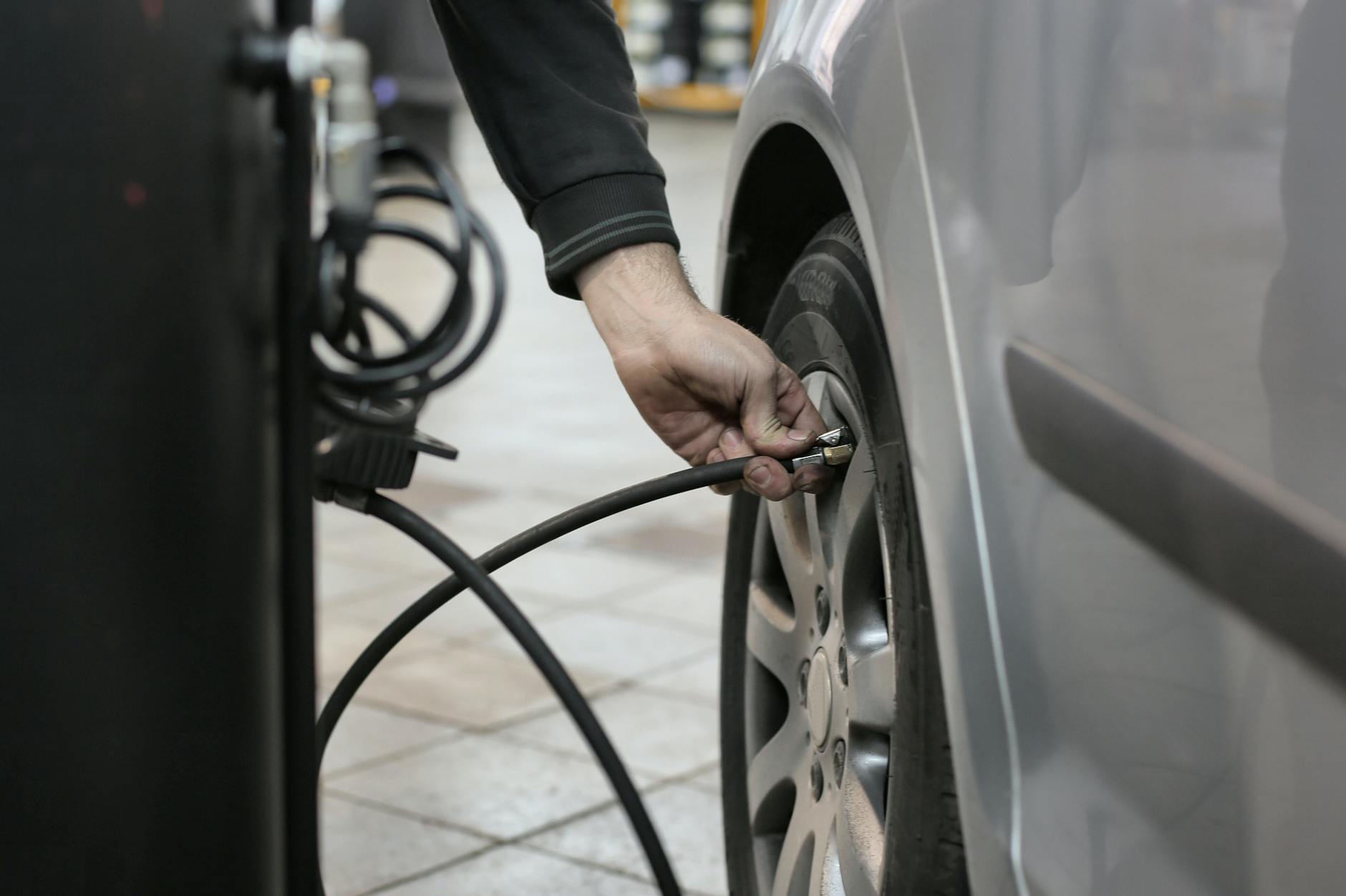
Checking pressure when tires are warm. Tire pressure must be checked cold — meaning the tire is at ambient temperature and hasn’t been driven on. Even a few miles of driving heats the tires and raises the pressure. A 20 PSI increase during normal highway driving is completely normal and expected. Check first thing in the morning before driving.
Bleeding air from warm tires. If you check after driving and the pressure is higher than your cold target, that’s normal. Do not release air. The pressure will drop back when the tires cool. Bleeding warm tires means you’ll be underinflated once they cool down.
Using gas station gauges. Truck stop and gas station air gauges are notoriously inaccurate. Invest in a quality digital tire pressure gauge — they’re $15-30 and worth every penny.
Only weighing by axle. As RVSEF’s data shows, side-to-side differences of 1,000+ pounds are common. An axle weight that looks fine overall can hide a badly overloaded tire on one side.
Not checking before every travel day. A slow leak can drop a tire several PSI overnight. Make morning pressure checks part of your pre-departure routine.
Temperature, Altitude, and Seasonal Changes
Tire pressure isn’t static. It changes with the weather, and RVers who travel across climate zones need to account for it.
Temperature: For every 10°F change in ambient temperature, tire pressure changes by approximately 1 PSI. Drive from a 90°F Texas campground to a 50°F Colorado mountain pass and your tires have lost about 4 PSI — enough to matter on a heavily loaded rig.
Altitude: For every 1,000 feet of elevation gain, pressure increases by about 0.5 PSI. But this effect is small compared to temperature. From sea level to 5,000 feet, the difference is only about 2 PSI. And since temperature usually drops as elevation rises, the two effects tend to cancel each other out.
The practical approach: Check and set your tire pressure cold every morning before you drive. If you follow this routine, temperature and altitude changes are automatically accounted for. There’s nothing special to calculate — just check, adjust if needed, and go.
One more detail: tire temperature can increase 40°F in just 30 minutes of direct sun exposure, producing falsely high readings. Check early morning, before the sun hits your tires.
TPMS: Your Early Warning System
A Tire Pressure Monitoring System (TPMS) tracks real-time pressure and temperature on every tire while you’re driving. It alerts you to slow leaks, rapid pressure drops, and overheating — problems you’d never notice from the driver’s seat until it’s too late.
Popular RV-specific systems include the TST 507 (monitors up to 14 tire positions across 5 trailers), TireMinder i10 (color display, affordable), and the Tymate M12-3 (solar-powered). Any of these is a worthwhile investment.
That said, a TPMS supplements your morning gauge check — it doesn’t replace it. TPMS sensors read pressure continuously, but a manual gauge check before you drive confirms your starting point and catches any overnight changes.
Don’t Forget Tire Age
RV tires often age out before they wear out. Your rig probably sits more than it drives, and rubber degrades with time regardless of tread depth.
How to check: Find the DOT code on your tire sidewall. The last four digits indicate the week and year of manufacture. “2622” means the tire was made in week 26 of 2022. If you see only three digits, the tire was made before 2000 — replace it immediately.
When to replace: The industry consensus is to have tires professionally inspected annually after 5-7 years, and to replace them by 7-10 years regardless of tread condition. For RV tires that sit in the sun for extended periods, err toward the shorter end of that window. UV exposure is one of the biggest accelerators of sidewall degradation — if your rig sits outdoors between trips, tire covers are a cheap way to buy time.
Quick-Reference Checklist
Use this before every trip:
- Check all tire pressures cold (morning, before driving)
- Use a quality digital gauge — not a gas station gauge
- Compare readings to your target PSI (based on actual weights + load/inflation table)
- Inspect sidewalls for cracking, bulging, or damage
- Check the DOT date code — replace tires older than 7 years
- Verify TPMS sensors are reading correctly (if equipped)
- Confirm all tires on each axle are at the same pressure
Get Your Weights, Then Get Your Pressure
Correct tire pressure starts with knowing your weight. Everything else — the tables, the math, the adjustments — flows from that single piece of data. If you haven’t weighed your RV yet, that’s step one. Arvee WeighSafe checks all your weight ratings in one pass and flags anything that’s over the limit — start there, then use the load/inflation tables to set your pressure.
For help with the weighing process, see How to Weigh Your RV at a CAT Scale. To understand the weight ratings on your rig, check out GVWR vs GAWR vs GCWR Explained. And for the loading mistakes that put most RVs over their limits in the first place, read Common RV Weight Mistakes and How to Fix Them.
Your tires are the only thing between your rig and the road — a handful of contact patches, each about the size of a dollar bill. Give them the right pressure and they’ll carry you safely. Get it wrong and you’re rolling the dice every mile.